제습 기본 기능
Sunday, February 24, 2019


현열과 잠열의 비교

Originally published on March 12, 2018 by BNP Media through the Building Enclosure Blog.
It's the first law of thermodynamics. The Law of Conservation of Energy states that energy can neither be created nor destroyed; energy can only be transferred or changed from one form to another.
This is the foundation of phase change in the physical environment. Molecular activity requires energy. The activity does not just magically happen.
Phase Change
When a material changes its state or phase (e.g., going from a solid to a liquid or a liquid to a gas) a large amount of heat must be absorbed (or released) in order to make the transition. This is a type of heat transfer that is distinct from conduction, convection, and radiation.The phase change of water is a common occurrence in the built environment. Therefore, it will be referenced here as an example.
Dry-Bulb Temperature
If the air in a room were completely dry, devoid of any moisture whatsoever, then its thermal properties could be described using a conventional thermometer to measure the dry-bulb temperature.However, the terrestrial environments, completely dry air conditions virtually never exist. There is always some amount of moisture present in the air in the form of water vapor. This vapor has a significant impact on thermal comfort.
Sensible Heat vs Latent Heat
Sensible heat is the “dry” heat in the air and relates directly to the dry-bulb temperature. This is the heat that one can "sense" with a conventional thermometer, as the term suggests. For example, heat added to an air mass from the glowing coil of an electric cooking range is an example of sensible heat.Latent heat is the “wet” heat captured in the air as water undergoes phase change from liquid to vapor via evaporation or boiling. For example, water vapor added to an air mass from a tea kettle boiling on the stove is an example of latent heat. The process is also reversible as latent heat is released when moisture is condensed out of the air mass.
Enthalpy is the sum of the sensible and latent heat in a given air-vapor mix. It is sometimes referred to as the total heat of the air. The units for sensible heat, latent heat, and enthalpy are the same:
BTU/lb of dry air.
Unlike sensible heat, latent heat is not directly "sensed" by a conventional thermometer with a dry-bulb. Latent heat can be borne out by comparing the dry-bulb temperature with the wet-bulb temperature.
Wet-Bulb Temperature
One way to measure the effect of moisture present in an air-vapor mixture is via wet-bulb temperature. It is measured using a thermometer with a wetted bulb moving rapidly through the air in order to facilitate evaporation. If the air is relatively dry, then evaporation will occur rapidly, resulting in a cooling of the thermometer bulb. As a result of the evaporative cooling, the measured temperature will be substantially lower than the dry-bulb temperature. The difference between the corresponding dry-bulb and wet-bulb temperatures is termed the wet-bulb depression. If the air is heavily moisture-laden, evaporation will be minimal and the wet-bulb depression will be small. In completely saturated air, the wet-bulb temperature will equal the dry-bulb temperature.Visualizing Sensible and Latent Heat
In order to visualize sensible and latent heat, let's consider the example of one pound of water (see figure below). First, let's cool it down to a 0-degrees Fahrenheit (°F) block of ice. The thermal energy required to heat the 0°F block of ice up to 32°F is 16 British Thermal Units (BTU; basically, the equivalent of one kitchen match of heat). This is sensible heat - the temperature of the ice was increased.What happens to water at 32°F? It achieves its melting point and will undergo a phase change from solid to liquid as additional thermal energy is provided. In order to fully change 32°F ice to 32°F water is 144 BTUs. The ice would take on all of that thermal energy and yet it would not increase in temperature one bit - that's latent heat.
In order to heat the pound of 32°F water up to 212°F, 180 BTUs will be required. But at 212°F, we reach the boiling point of water and once again phase change will occur as additional thermal energy is taken on. However, converting water to vapor requires a tremendous amount of energy: 970 BTUs.
Once the water is completely evaporated, the vapor can take on additional energy inputs. Its sensible heat will continue to increase. The pressure of the water vapor will also increase as the additional thermal energy increases molecular activity.
 |
| Sensible and latent heat graphically depicted for a pound of water. Illustration by Daniel Overbey. |
건구온도, 습구온도 및 엔탈피의 관계
Dry-Bulb Temperature, Wet-Bulb Temperature and Enthalpy
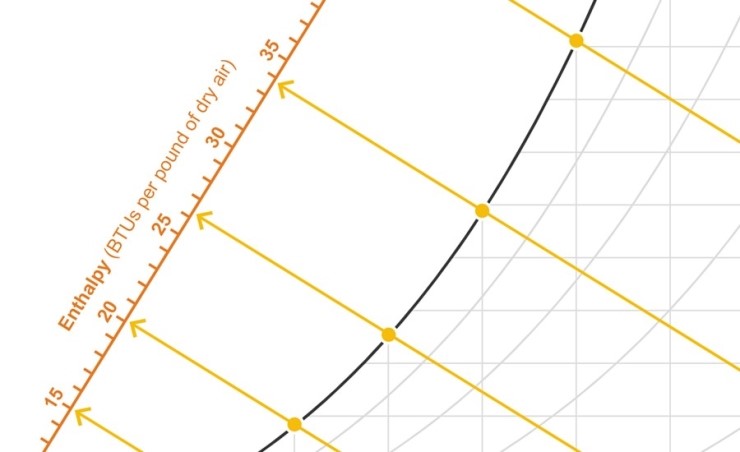
There is energy in the air all around us. Some of it exists in the form of thermal energy that one can sense—heat in air that impacts one's perception of thermal comfort. But there is also an energy embodied in the vapor present in the air. While this "hidden" heat is not experienced as warmth, it certainly has a bearing on thermal comfort as well.
In order to distinguish between these two types of heat in the air, one must determine the air's enthalpy.
Enthalpy
Enthalpy is a term used to describe the total amount of heat present in an air-vapor mix. It is the sum of both the sensible and latent heat present in the air. Recall that sensible heat is the “dry” heat in the air related to dry-bulb temperature (think glowing coils on an electric cooking range); while latent heat is the "wet" heat release into the air as water phase-changes to vapor (think vapor released to the air as a tea kettle's contents boil atop said cooking range). (See Thermal Dynamics: Visualizing Sensible Versus Latent Heat for more information on sensible vs latent heat.)
The units for sensible heat, latent heat and enthalpy are all the same: BTUs per pound of dry air (BTU/lb).
Plotting Dry-Bulb and Wet-Bulb Temperatures
In order to ascertain how much sensible versus latent heat is present in air-vapor mix, both the dry-bulb and wet-bulb temperatures must be defined and plotted on the psychrometric chart.
If the air in a room were completely dry, its thermal properties could be defined using a conventional thermometer to measure its dry-bulb temperature. On the other hand, if a thermometer with a wetted bulb moved rapidly through the air, evaporation would be induced to some degree. If the air is relatively dry, evaporation is rapid, resulting in a cooling of the bulb. This would result in a measured temperature substantially lower than the dry-bulb temperature. If the air is saturated, the dry-bulb and wet-bulb temperature readings may be similar—perhaps virtually identical. The difference between the dry-bulb and wet-bulb temperature in a given air-vapor mix is known as the wet-bulb depression. (See Thermal Dynamics: Visualizing Sensible Versus Latent Heat for more information on dry-bulb temperature and wet-bulb temperature.)
The wet-bulb depression at various conditions can be plotted on the psychrometric chart (see Figure 1). Equipped with both a dry-bulb and wet-bulb temperature reading, one can determine precisely where the air-vapor mix lands on chart.
 |
Figure 1: At 100 percent saturation, the wet-bulb (WB) temperature equals the dry-bulb (DB) temperature. In order to maintain a constant WB temperature, the humidity ratio must be lowered as the DB temperature increases. Notice the WB lines run parallel with each other. Illustration courtesy of author.
|
The web-bulb temperature lines maintain a constant enthalpy—meaning as condensation or evaporation occurs, there will be a proportionate give-and-take of sensible and latent heat and the total BTUs per pound of dry air will remain the same. The enthalpy can actually be scaled across the psychrometric chart (see Figure 2).
 |
Figure 2: Enthalpy lines (which run parallel with wet-bulb temperature lines) provided to a scale overlaid on the psychrometric chart. Illustration courtesy of author.
|
The dry-bulb and wet-bulb temperature of any air-vapor mix can be easily determined using a sling psychrometer. Armed with such data, one can easily ascertain the humidity ratio, relative humidity and enthalpy of any air-vapor mix—all of which provides critical information to assess thermal comfort and environmental quality.
밀도와 비중의 차이
밀도 密度 density 요약 단위부피에 대한 질량. 즉 물체의 질량을 부피로 나눈 것이다. 단위는 킬로그램퍼세제곱미터·그램퍼세제곱센티미터·파운드퍼 세제곱피트 등이다.
같은 물질에서 비교하면, 보통 고체는 밀도 가 크고, 액체는 고체밀도에 가깝지만 약간 작으며, 기체는 가 장 작다. 기체의 밀도는 거의 압력에 비례하고 절대온도에 반비 례하여 변화한다. 설명 단위부피에 대한 질량. 즉 물체의 질량을 부피로 나눈 것이다.
단위는 킬로그램퍼세제곱미터(㎏/㎥)·그램퍼세제곱센티미터(g/ ㎤)·파운드퍼세제곱피트(lb/ft) 등이다. 같은 물질에서 비교하 면, 보통 고체는 밀도가 크고, 액체는 고체밀도에 가깝지만 약 간 작으며, 기체는 가장 작다. 기체의 밀도는 거의 압력에 비례 하고 절대온도에 반비례하여 변화한다.
같은 물질의 고체·액체 ·기체(예:얼음·물·수증기) 밀도의 비는 그 속에 분자가 얼마 나 빽빽하게 쌓여 있는가의 정도를 나타낸다. 혼동하기 쉬운 개 념으로서의 비중은 어떤 물질의 질량과 그와 같은 부피의 표준 물질 질량의 비이며 무명수이다.
넓은 의미로는 질량밀도 외에 각종 물리량의 단위부피당·단위넓이당·단위길이당의 값도 포 함하며, 이를 각각 부피밀도·넓이밀도(면밀도)·선밀도라 한 다. 예를 들어 분자의 수밀도는 단위부피당 분자수이며, 철사 의 선밀도는 단위길이당 질량이다. <인구밀도> 같은 용어가 쓰인다.
----------------------------------------------------------- -------------------
비중 比重 specific gravity 요약 각 물질의 질량이 그것과 같은 부피를 가진 표준물질의 질량의 몇 배인가를 나타낸 수치. 엄밀하게 질량은 일정 압력에서의 관 성을 측정함으로써 결정되는데, 보통은 같은 장소에서의 무게비 로 결정되므로 비중이라고 한다.
일반적으로 액체나 고체는 4℃ 의 물 1㎝³를 1g으로 하고 이것을 표준으로 한다. 기체의 경우 는 0℃, 1기압에서의 공기를 표준으로 취할 때가 많다. 설명 각 물질의 질량이 그것과 같은 부피를 가진 표준물질의 질량의 몇 배인가를 나타낸 수치.
엄밀하게 질량은 일정 압력에서의 관 성을 측정함으로써 결정되는데, 보통은 같은 장소에서의 무게비 로 결정되므로 비중이라고 한다. 일반적으로 액체나 고체는 4℃ 의 물 1㎝³를 1g으로 하고 이것을 표준으로 한다. 기체의 경우 는 0℃, 1기압에서의 공기를 표준으로 취할 때가 많다.
또 4℃ 물의 밀도는 0.999973g/㎝³이므로 비중의 0.999973배가 CGS단 위로 나타낸 밀도와 같은데 실제 사용할 때는 그 차이를 무시해 도 지장은 없다.
압력의 단위
압력의 단위
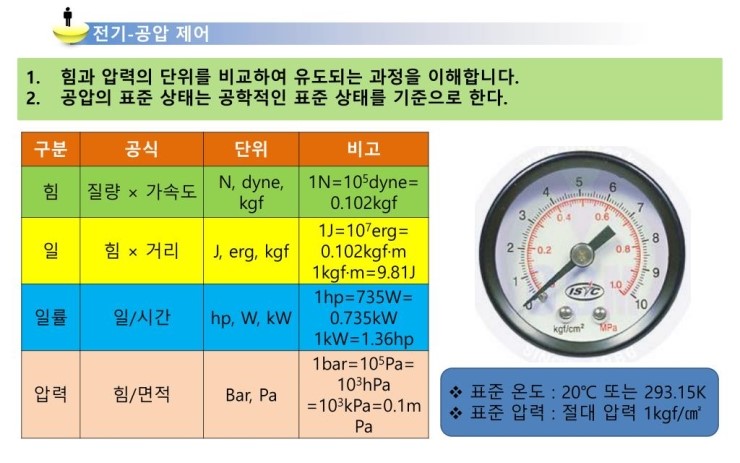
압력 (Pressure)은 유체에 의한 단위면적당의 수직력이다. 단위로는 Pa, N/㎡, Bar, kg/㎡ 등을 사용한다. 압력계 등의 실용상의 단위로는 ㎏/㎠ (at로 표기) 흔히 사용하며 이것을 공업기압이라고 한다.
1 표준기압: 0℃에서 수은주가 760 mm (0℃에서의 수은의 밀도 = 13.5951 g/㎤)가 되는 압력이며 이것을 1 atm (Atmosphere의 약어)으로 표시한다.
1 atm = 760 mmHg = 760 * 13.5951 mm g/㎤ = 760 * 13.5951 * 1/10 ㎝ * 1/1000 ㎏f /㎤ = 1.0332276 ㎏f/㎠ =1.0332276 ㎏f/(1/100)³ ㎥ = 10332.276 ㎏f/㎡ = 10332.276 * 9.80665 ㎏∙m/(s²∙㎡) = 101325.0114 N/㎡ ≒ 101325 N/㎡ = 101325 Pa
1 atm = 760 mmHg = 760 * 13.5951 mm g/㎤ = 760 * 13.5951 * 1/10 ㎝ * 1/1000 ㎏f /㎤ = 1.0332276 ㎏f/㎠ =1.0332276 ㎏f/(1/100)³ ㎥ = 10332.276 ㎏f/㎡ = 10332.276 * 9.80665 ㎏∙m/(s²∙㎡) = 101325.0114 N/㎡ ≒ 101325 N/㎡ = 101325 Pa
잠열과 감열 (Latent Heat & Sensible Heat)
잠열과 감열 (Latent Heat & Sensible Heat)
액체를 가열하면 열 에너지는 먼저 액체의 온도상승과 체적팽창에 사용되며 (액체의 경우 체적증가가 보통의 경우 매우 작다.) 다시 가열을 계속하면 어떤 온도에서 증발이 일어난다. 일정 압력하에서 증발이 일어나기 시작하면 온도 상승은 중지된다.
이 때 가해진 열 에너지는 내부 에너지의 증가와 체적팽창에 필요한 일을 하게 된다. 일정한 압력하에서 액체 1㎏을 전부 증발시키는데 필요한 열량을 증발열 또는 증발의 잠열이라고 한다. 한편, 감열은 단위 질량의 물체의 온도를 상승시키는데 필요한 열량을 의미한다.
증발잠열 @ 273.15K (0℃)= 2.5016 x 10^6 J/㎏
참고 1: 공학단위계에서 사용하는 ㎉/㎏으로 환산하면 다음과 같다.
증발잠열 = 2.5016 x 10^6 J/㎏ = 2.5016*10^6/4186.047 ㎉/㎏= 597.6 ㎉/㎏
참고 2: 자연상태의 물이 증발될 때의 증발잠열은 물의 온도에 따라 다르다. 물의 온도가 높을 수록 증발잠열은 줄어든다. 위의 증발잠열은 물의 온도를 0℃를 기준으로 한 것이며, 물의 온도가 30℃인 경우는 2.4307 x 10^6 J/㎏, 50℃인 경우는 2.3829 x 10^6 J/㎏이다.
비체적 (Specific Volume)
비체적 (Specific Volume)
단위중량의 물질이 차지하는 체적을 비체적이라고 하며 v ㎥/㎏f로 표시한다. 단위체적의 물체의 중량을 비중량 (Specific Weight)이라고 하며 γ㎏f/㎥로 표기한다. 따라서 비중량의 역수는 비체적인 관계가 성립한다. 즉, v = 1 / γ 또는 vγ=1
밀도 (Density) ρ는 단위체적에 대한 물체의 질량이며 비중량 γ와의 관계는 ρg = γ ㎏f/㎥이다. (여기서g는 중력가속도이며 g = 9.80665 m/s² 이다.)
ρ = γ ㎏f/㎥ / (9.80665 m/s²) = γ ㎏/㎥ * (9.80665 m/s²) / (9.80665 m/s²) = γ ㎏/㎥
비중 (Specific Weight) δ는 동일체적의 물의 질량에 대해서 몇 배인가를 표시하는 무차원량이다.
습공기의 비체적은 건공기 단위 무게당 습공기의 부피로 상태방정식 (pdaV = ndaRT) 으로부터 비체적 관계식을 유도할 수 있다.
밀도 (Density) ρ는 단위체적에 대한 물체의 질량이며 비중량 γ와의 관계는 ρg = γ ㎏f/㎥이다. (여기서g는 중력가속도이며 g = 9.80665 m/s² 이다.)
ρ = γ ㎏f/㎥ / (9.80665 m/s²) = γ ㎏/㎥ * (9.80665 m/s²) / (9.80665 m/s²) = γ ㎏/㎥
비중 (Specific Weight) δ는 동일체적의 물의 질량에 대해서 몇 배인가를 표시하는 무차원량이다.
습공기의 비체적은 건공기 단위 무게당 습공기의 부피로 상태방정식 (pdaV = ndaRT) 으로부터 비체적 관계식을 유도할 수 있다.
아래 수식에 사용된 기호의 의미는
V: 습공기의 체적, ㎥
Mda: 건공기의 질량, kg [= 건공기 비분자량 (Relative Molecula of Dry Air) * 건공기 몰 수
(Number of Moles of Dry Air]
nda: 건공기의 몰 수, mol (물질에 있는 입자의 수)
R: 일반기체상수 (Universal Gas Constant), 8314.41 J/(kmol∙K))
Rda: 건공기 기체상수 (Dry Air Gas Constant), 8314.41 / 28.9645 = 287.055 J/(kg∙K))
T: 절대온도, K
p: 대기압, N/㎡ (p = pda + pw)
pda: 건공기의 부분압, N/㎡
pw: 수증기의 부분압, N/㎡
pw: 수증기의 부분압, N/㎡
W: 절대습도, kg vapor/kg dry air
v = V / Mda = V / (건공기 비분자량 * 건공기 몰 수) = V / (28.9645 * nda)= (ndaRT / pda) / (28.9645 * nda) = RT / (28.9645 * (p - pw)) = RdaT / (p - pw)

Subscribe to:
Posts (Atom)
-
1. 개 요 지구상의 공기는 질소 , 산소의 주성분과 아르곤 , 탄산가스 , 네온 등의 기타 미량의 기체로 구성되며 여기에 수증기가 포함되어 있다 . 대기 중에는 이들 공기의 구성물질 이외에 자연이나 인간이 발생하는 먼...
-
비체적 (Specific Volume) 단위중량의 물질이 차지하는 체적을 비체적이라고 하며 v ㎥ / ㎏ f 로 표시한다 . 단위체적의 물체의 중량을 비중량 (Specific Weight) 이라고 하며 γ ㎏ f/ ㎥로 표기...
-
Dry-Bulb Temperature, Wet-Bulb Temperature and Enthalpy There is energy in the air all around us. Some of it exists in the form...


열 교환기 제어(1)
- Heat exchanger 는 ‘warm side’ 와 ‘cold side’ 사이의 열을 교환하는 시스템이다 . ‘warm side’ 는 발전기로부터 남은 열 로 구성이 된다 . - ...